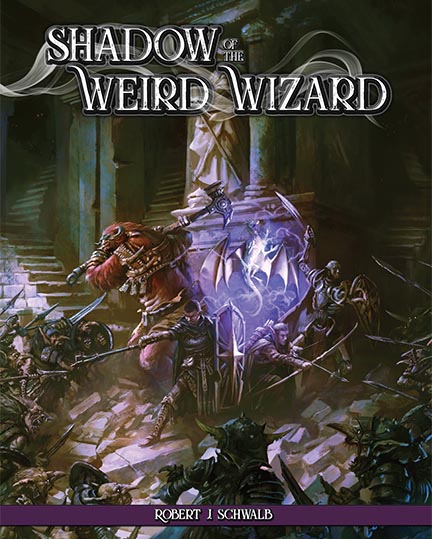
Shadow of the Weird Wizard

Posted 10 Sep 2025 to Fantasy

Bold heroic fantasy.


XP Card

Sessions GM'd: 40
Sessions as Player: 0

I Used

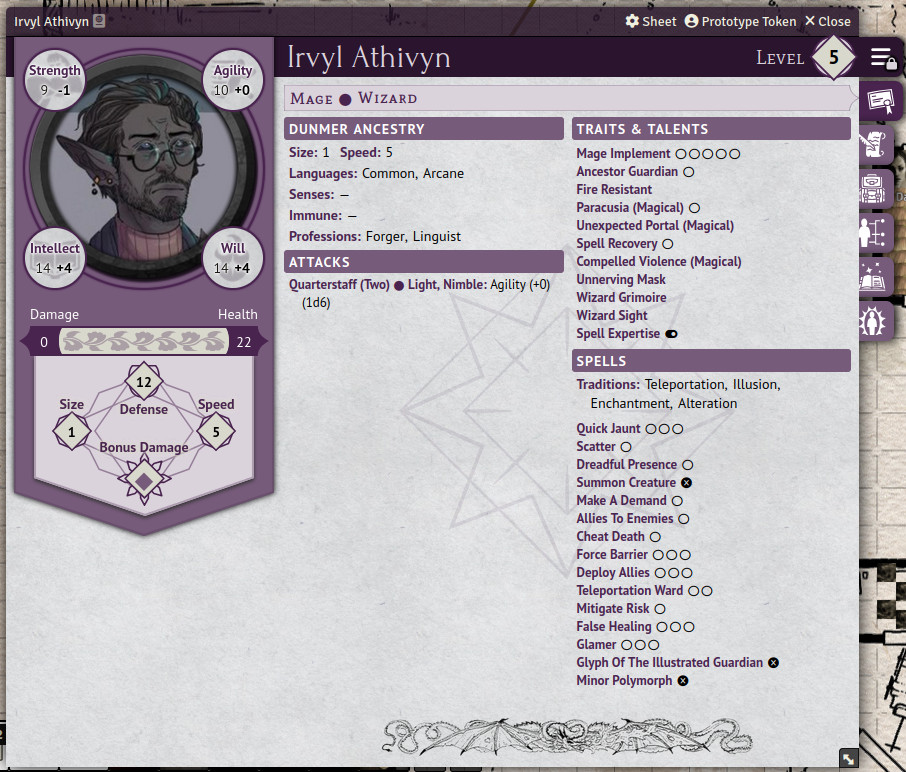
Shadow of the Weird Wizard and Secrets of the Weird Wizard, the two core books. I played using Foundry. As a Backer, I had access to a lot of published adventures for WW, but I only used One Bad Apple. I ran two short campaigns set in the Borderlands, and then one longer campaign set in the Elder Scrolls setting of Tamriel.

Overview

A heroic system that creates a lot of laughs and fun around the table. PCs feel very powerful from early on, and you can have some truly epic adventures. This game is criminally under-marketed and needs to be discussed more.


The Good

  • Plenty of ancestries - and they're optional. The author made the bold decision to only include Human as an ancestry in the player book. They also designed a ton of other ancestries, but put them in a separate book. I like this. I don't see it as a money grab. I appreciate that the GM is now invited to pick and choose which ancestries will be playable in their campaign, without players just assuming that it is a free for all. I do this because it helps enforce a strong theme for the campaign (e.g. to only offer Fey related ancestries for a Fey game). Along with the goblins, elves, dwarves, tieflings (cambions) and other non-human ancestries, it has a lot of weirder options too, like harpies, tatterdemalions (abandoned clothing people?), haren (rabbit people), centaurs, etc. I don't think I'll ever use those in my games, but the variety is wonderful.
  • Magic is fun and powerful. The spells themselves are vivid and powerful. Frequently a scene changed dramatically when a mage dropped a spell that shocked and excited fellow players. Many spells do not allow enemies a saving throw, and require no roll from the caster to succeed. They just work. And well! Coming from playing Pathfinder 2e, the power level of magic spells between these two rpg systems really gave me whiplash. Sometimes a Weird Wizard Novice rank spell, available to a level 1 character, feels equivalent to a level 3 or 4 spell in Pathfinder. For example, the Unexpected Portal talent (like a cantrip, can be used as often as the mage likes) from the Teleportation tradition was used to great effect by our mage. It's like D&D's Misty Step, but you cast it on enemies. Think how powerful, tactically, that is. It is a cantrip in Weird Wizard. Our party created a bottleneck in a dungeon corridor; the enemies clustered around the bottleneck. Then our mage used Unexpected Portal in successive rounds to teleport (no saving throw) enemies one-by-one into a killzone for the rest of the party to dogpile. These spells are great fun and create a lot of laughs around the table.
  • Fighting characters have options. The warrior characters are not short shrift. As they level up, they earn Bonus Damage. I don't like the name of this ability; it should rather be called Combat Points. You can use them to give extra damage dice to your attacks, yes. But you can also use them to buy a second attack or various maneuvers like Disarm. So your warrior characters have points that refresh each turn for them to spend on doing cool stuff, or if they want, to do big pools of damage.
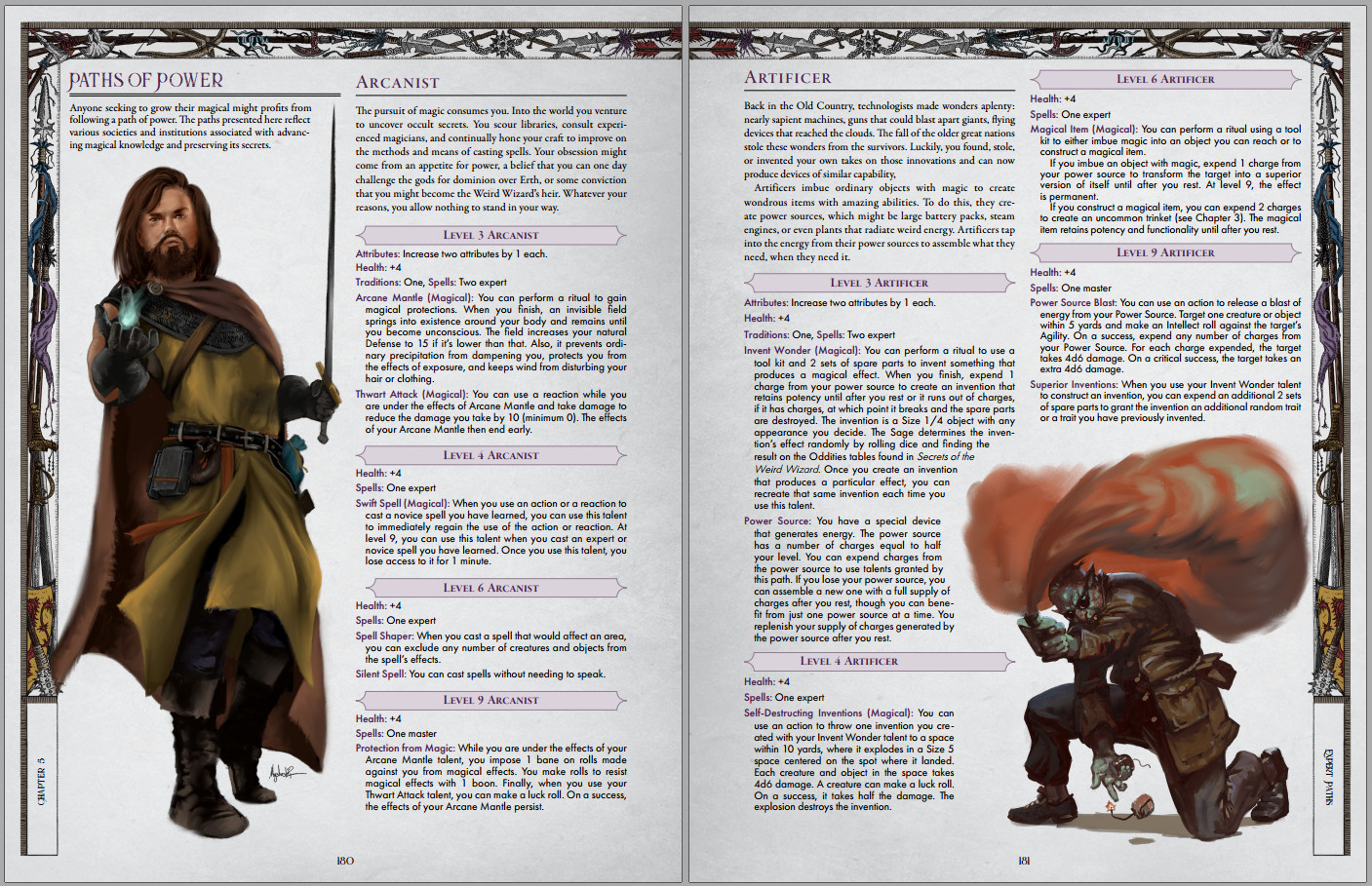
  • Magic allows specialisation. If you play a spellcasting character, you will choose a handful of Traditions that you know. Each Tradition is a theme of magic, such as Pyromancy, Enchantment, Necromancy, etc. There are 33 of them (a lot!) and each Tradition has 18 spells. So there is plenty of variety, and the spells encourage creative use. I find this really good - it means that your magic using characters will have a flavour all of their own. And even when you have played a mage before, there is replayability. If you played a cryomancer with time magic before, you can play a symbolist with alchemy and technomagic next time.
  • Good bestiary. A wide variety of monsters are provided in the GM's book. Many are important staples that a GM needs to be able to call upon, such as various types of undead warrior. You have all those, naturally, and they are important because they make it easy to use the game system in a homebrew setting. The bestiary also includes a good collection of faeries and unique weird creatures that are peculiar to the setting.
  • Lucks Ends is a cooldown. Some abilities for PCs and monsters can be used once, and then refresh when Luck Ends. This means that at the end of each round, you flip a coin (roll 1d20, beat 10) and on a success, the ability is back and available to be used again. I find this really random in a fun way. The probability is just enough that you feel like there is a good chance of it happening, but it's not reliable, and you still fist bump when it happens.
  • Lots of adventures, and more coming. The author has a rigorous publishing pace, and at one stage a new adventure was coming out every two weeks. They're okay. Some of them would be better if they included maps, and many of them are solidly grounded in the default setting of the Borderlands.
  • Great initiative system. Monsters go first, unless players choose to give up their Reaction and go first. This gives a little tactical trade off for the players to think about every round. Your Reaction is useful, for example it can be spent to Dodge and give enemies a slight penalty to their attack. It is also used to trigger many of the special abilities your character has. So giving up your Reaction to go first feels like a real tactical decision.
  • PCs feel powerful early. Your PCs will feel competent and powerful against other human enemies around level 3. By level 4 they are taking on vampires and ogres routinely. In fact, a Vampire is rated a Difficulty 8 creature, which is appropriate for a level 1 party. However, with low hit point pools and high damage output, there remains tension in battle and the players can be quite squishy. Their ability to Take The Initiative and act before monsters is important because often you do *not* want to be receiving an attack from an enemy.
  • Boons and Banes are easy to use. You want to climb the wall? Well, it's slippery and raining so that's 1 Bane. But you have the Sailor profession and spent time climbing the rigging, so that's 1 Boon. They offset each other, so make your roll. Boons give +1d6 and Banes give -1d6 to your roll. In practice they matter very little. The 1d20 is the biggest determinant of success.
  • Downtime activities are provided. I liked this, and we used them in every campaign I ran. They're flexible enough for our needs, and quick to run.
  • The Not-So-Good

  • A few too many rules. These books could have benefitted from some aggressive editing. Whole topics could have been deleted to cut down the number of pages and create a lean and mean document. The books include guidelines for many edge case situations, for example how to make a ruling on a player attempting to communicate using pantomime without words. Did we really need that? Also many topics begin halfway down a page, or near the bottom of a page and then carry over to the following page. I find this annoying. I created my own reference document to alleviate this pain and condense the text. See below for the link.
  • Some confusing rules options. There are some moves you can make that feel unnecessarily confusing to me. For example, there is an attack option called "Driving Attack" which allows you to try and force an enemy to move. And then on the next page there is a different move called "Shove" which ... also allows you to try and force an enemy to move. The reason for two different moves that aim to accomplish the same thing is unclear without analysing the differences in detail, and this is one example of needless complexity in the system, in my opinion.
  • Published adventures seem very human centric. Despite the wide variety of playable ancestries, including centaurs and spriggans and sprites, all of the published adventures (so far) are very focused on humans. Oh no the human village is being threatened by a cult of humans! My party of spriggans and fauns didn't care. Right now, 5 out of the 7 published Novice quests are about a human town being threatened by (insert one of: Goblin, Orc, Cult). It would be great if we could get some adventures that embrace some of the weird ancestries provided, and show us how their cultures work.
  • Superheroic power levels. By level 3, both groups of players had PCs who could teleport and fly. Magic for PCs is flashy, ubiquitous, and quite powerful. PCs quickly become quite strong, and can survive a variety of dangerous situations. They kick ass and take names. At level 3, our party was challenged by a bandit crew. Our mage exploded the bandit leader with a spell that has no saving throw and no roll required to hit. The bandits scattered and ran. It felt like what would happen if a gang of skateboarders tried to mug the Avengers. Reminder: they were level 3. The scale of your campaign needs to be calibrated accordingly. The world needs to be invaded by demons or something, because bandits won't cut it. By the way, our mage could cast that spell 3 times per day. In another scene, our party of level 3 characters attacked a stronghold with 20 bandits inside. It was a bloodbath, like a scene from John Wick, as the party used clever positioning and thrashed the bandits despite being outnumbered.
  • The Borderlands setting doesn't quite match the system. The game would be well suited to a "full magic" setting such as Eberron or World of Warcraft, where magic is strong and used as a tool by governments and factions. Where armies have magical siege weapons, regiments of battlemages ride griffons, and teleporting assassins are expected. The setting of the Borderlands doesn't suggest this vibe to me. Villages are very mundane, and the locals are bewildered and completely unable to deal with simple fey threats. Everyone, even major factions such as the church and governments seem ill-prepared to deal with threats like faeries, devils, and the Weird Wizard. Where are the airships? Mighty paladins of the Church who hunt demons? Elemental cannons mounted on awakened pirate ships? Teleportation facilities between cities? None of this is described, and it makes players feel very powerful in the world from early on. Level 1 characters can melt a castle portcullis (Alchemy), send messages 60 miles (Aeromancy), create perfect disguises (Alteration) - and that's just the Traditions starting with the letter A. Yet NPCs in the published adventures can do none of these things, and have no defences against people who can. In other words, the game system is full of magic, but the Borderlands feels like a medium magic setting.
  • At time of writing, Foundry system not ready. The game system is being written in a way that is tightly automated. That's good. It also requires that a programmer code every spell and ability. That's bad. Currently, September 2025, the compendium is not available, and has been in development for 2 years. The game system is seeing weekly updates and changes. So without a compendium, you have to capture a lot of content yourself, and the VTT game system is honestly not ready for prime time right now. I find this frustrating because the game has been out for a long time. Publishers need to ensure that some VTT content is available at launch. New fantasy RPGs are released regularly, and your new game has a narrow window while it is being discussed online and new players are attracted to it. Make sure your game is ready to play online at launch.
  • Lots for a GM to track. There are 16 kinds of Conditions (called Afflictions) that cause ongoing damage or give boons or banes to specific actions (e.g. Weakened or Confused). On top of tracking 2 types of hit points for each goblin (Damage and Health), I also need to remember which of them have used their Reaction each round. Many abilities use the Luck Ends cooldown that needs to be rolled at the end of each round. Ideally the VTT should help track all this for you.
  •  
     

    Verdict

    In terms of game complexity, its competing with Pathfinder and D&D directly. However, its magic spells are really quite strong compared with those systems. It's tone is very heroic, with the PCs feeling remarkably powerful quite early on (although still quite squishy). This game is epically heroic and very high magic. It would work well in a high magic heroic setting, like World of Warcraft. The stakes in your campaign need to be suitably epic.

    Useful?

    4

    No signup.
    Just let me know.


    Share this page


    © 2026 SpandexAndy