Savage Worlds Adventure Edition (SWADE)

Posted 16 Feb 2026 to Sci-Fi

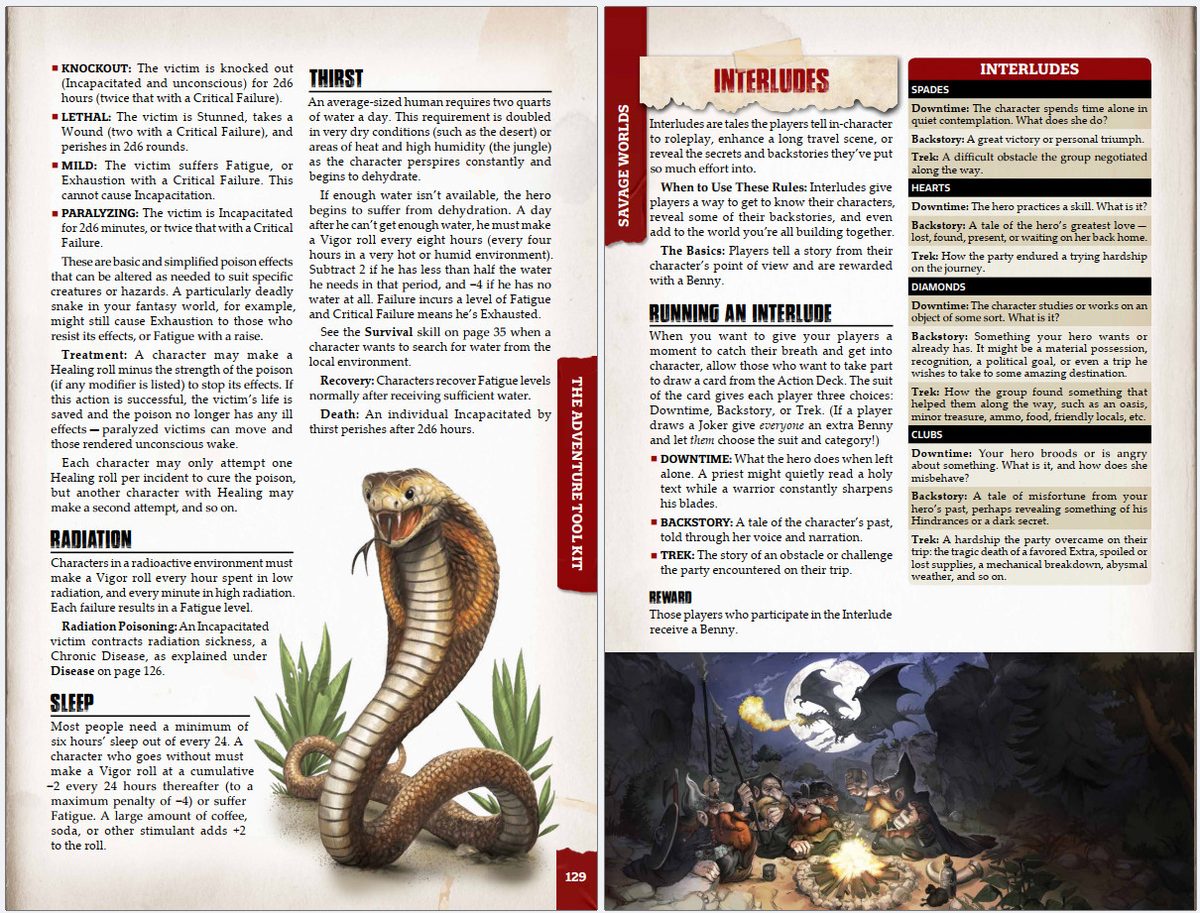
A very versatile system, which can be used for a wide range of settings. It thrives in the pulp-action genre (e.g. Indiana Jones).

 
Savage Worlds Adventure Edition (SWADE) — image 1
 

XP Card

Sessions GM'd: 11
Sessions as Player: 0

I Used

Savage Worlds Adventure Edition, core book. I purchased the module for Foundry, which includes the bestiary and all the abilities for drag-and-dropping onto character sheets. I also used the Star Wars Companion, which is a fan-made book, backed up with a comprehensive Foundry compendium.

Overview

Our Star Wars campaign was set a few years before the Battle of Yavin, in the classic Empire era. The campaign was about a crew of young Jedi (child survivors of Order 66) being guided by a ghost master to visit a handful of ancient locations to collect important relics and move them for safekeeping. There are many game systems that have been used for Star Wars over the years, and I considered all of them before starting the campaign. I didn't want to use funny dice and I'd already tried the WEG d6 game.
 
Savage Worlds Adventure Edition (SWADE) — image 2
 

The Good

  • Versatile system for many settings. You could run a scifi Firefly game as easily as a Fantasy intrigue drama, or even a Superhero game. It is a generic system, which I enjoy and would like to try again. Having run this campaign set in the Star Wars setting, I can see the possibilities of running Shadowrun or Curse of Strahd or lots of other settings. All with the same ruleset.
  • Adaptable for many styles. There is a list of optional rules you can use in your campaign which tweak the way the game feels. Do you want it more gritty? Do you want it more pulpy? Guidance is given, and even a menu list of all of them, so a GM can easily communicate with the players which ones apply for a campaign.
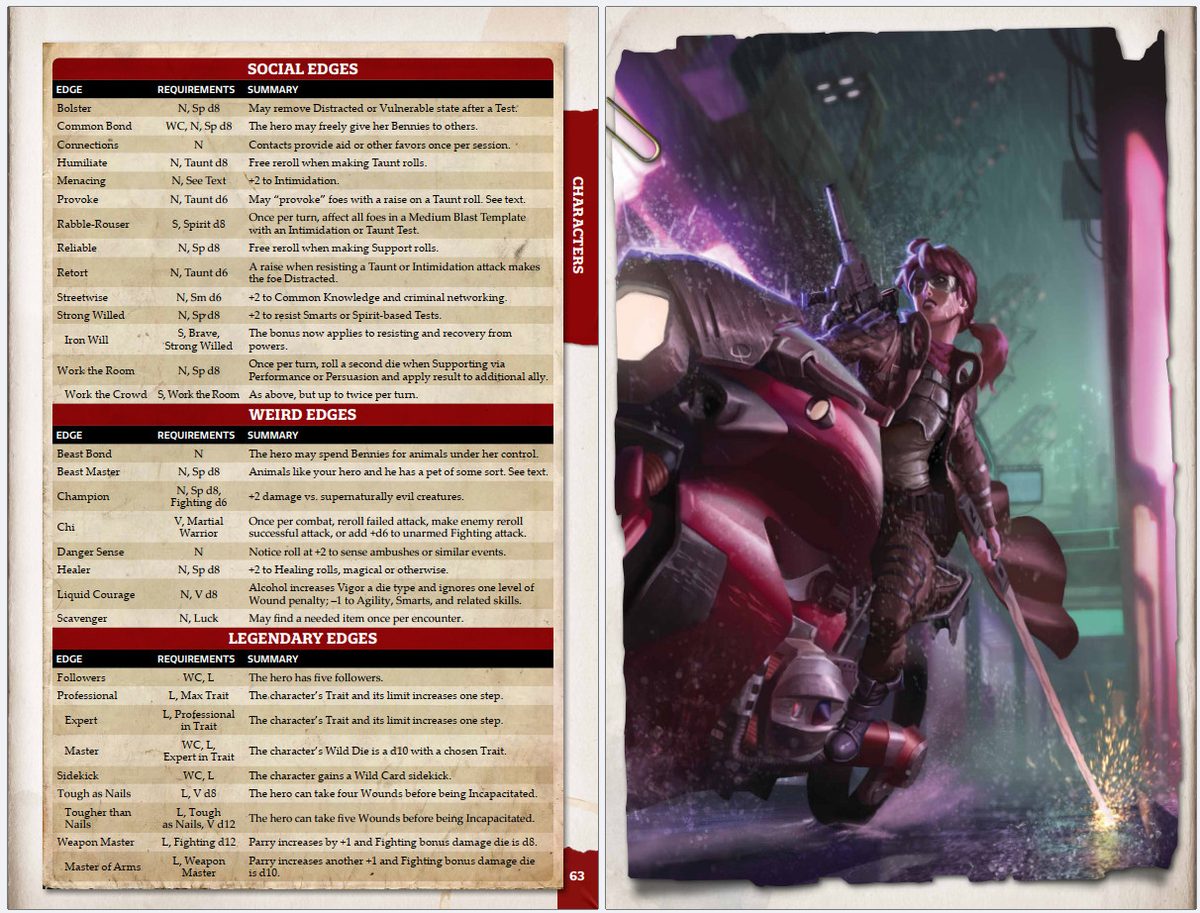
  • Non-combat characters are viable. There are a number of social abilities you can buy, and they have combat utility. It is great to offer options for players who do not want violence. For example, there are a number of Leadership Edges that can be used to give the party bonuses for their actions, and also Social Edges that can be used to taunt and debuff the enemy.
  • Edges and Hindrances. These are advantages and disadvantages you pick for your character at creation. They are like Feats, and you gain them when advancing also. Many of them are personality traits, such as cowardly. These are good roleplay hooks, built into the core game, where a player can be rewarded for taking a fun disadvantage.
  • Intuitive core mechanic. Your stats and skills are represented by dice. A strong character might have d10 for Strength, but only d6 for Smarts. That's the dice they roll. Easy. Your basic target number is 4, but you apply modifiers depending on the situation to increase or decrease this.
  • Metacurrency are your real hitpoints. Players have Bennies, and so does the GM. You use them to reroll dice and buy autosuccesses on certain rolls. Bennies can really help to get you out of trouble, and I found the first indicator of whether the party is winning a difficult fight, is how quickly they spend their Bennies.
  • Random movement distance. If you want to run across the battlefield, you roll your Pace to see how far you can dash. This is great! No longer can players move about the battlefield with Chess precision. You've got to eyeball it and take a chance. I found this a refreshing change.
  • The Not-So-Good

  • Exploding Dice. If you roll a 6 on your d6, then you roll again and add the result. This happens with all dice sizes and all rolls. The effect is that sudden and shocking results happen in combat, and it is surprisingly frequent that the clumsy enemy B1 Battle Droid who is only rolling 1d4 to attack, manages to get a result above 10, and hits you from across the battlefield and despite your cover! When the enemy is rolling damage, they can devastate you with 25 damage even though they were only rolling 2d8. Some might say this is exciting as it adds unpredictability in tense scenes. Overall I don't like it because one tends to feel that fluke determines success or failure.
  • Some missing details from Science Fiction Companion. For example, rules for scanning ships not provided. It is a common trope in scifi for a ship to scan for life forms, and players will want to know whether an enemy ship has shields or not. I would have liked some guidance on how to do this. I had to make it up.
  • Enemy stat blocks require mental work. The stats do not seem to consistently factor in the abilities of the creature. Mostly they do, e.g. armour is already added to Toughness. Sometimes they don't, e.g. the Scale of a creature is not already built into their Parry or their Attack. When listing the melee damage, the stat block will say "STR+d6" which requires me to cross reference to see what its STR is. Rather just tell me "STR (d6)+d6". Come on. When you read below about how mathy the game can be, these small inconveniences add to the GM's burden unnecessarily.
  • Enemies work like PCs. The rules for running monsters and enemies are exactly the same as running players. They are built using the same Edges and Powers. Special enemies (called Wild Cards) also have Bennies like players. That has the effect of adding mental burden to the GM and simultaneously making all enemies kinda similar. Monsters in the bestiary don't have a variety of cool abilities to use in combat which might differentiate them. Fighting a minotaur is largely the same as fighting a goblin, but with bigger numbers.
  • Lots of pedantic modifiers. Combat involves a lot of adding and subtracting modifiers in order to calculate what to roll. This adds a lot of mental overhead. For example; "The tie fighter comes up behind your ship and shoots you!". Okay, the pilot's skill is d6 for shooting, and the target number is your Parry which is 2. But the tie fighter is a Size 7 ship, and you are Size 14, so (checks table) that is a +4 to his attack roll. And his lasers are Linked so that is another +1 to hit. But he is already Wounded, so that is -1 per wound. So he will roll d6+4. That is a lot of plussing and minusing, and you have to do it several times each turn.
  • Maths. After you roll a success, you do another calculation to determine damage. How much did you beat the to-hit target number by? Count how many multiples of 4 you beat the target number by. Each of those is +1d6 damage. Roll it. Did you beat the minotaur's Toughness? If yes, then he is Shaken. Now consider Armor and whether your attack had any Armor Piercing effect. Deduct those Toughness points. And now subtract the Toughness from the damage you rolled, and divide the answer by 4. That's how many Wounds he took. It is crunchy! This is the single biggest factor that puts me off running Savage Worlds in future! This was quite mind boggling when we started the campaign. It took 5 sessions for the system to click with me. There are online tools to help with the maths (https://savaged.us/tools/big-damage-calculator/) and (https://immaterialplane.com/apps/raises/).
  • Star Wars Companion book. This fanmade book presents new equipment and new Force powers for your Jedi. I found it quite longwinded, for example the Force power to push enemies over required almost a full page to explain. Weapon damage and armour ratings seemed too high, compared with core SWADE. Having used it, next time I will just play using only core SWADE. All Jedi powers can be represented using the core book anyway.
  • Vehicles are difficult to use. The main problem is that weapons can be used against people, but they can also be used against vehicles. Vehicles are like people, except they have massive Toughness. Anti-vehicle weapons do enormous damage to try to defeat this. Vehicles also have a Scale, for example a starship might be size 14 but a speeder might be side 6. There is a table that shows you how a difference in Scale modifies your attack. It was quite a lot of unnecessary minutiae.
  •  
    Savage Worlds Adventure Edition (SWADE) — image 3
     

    Verdict

    I like this game. I am drawn to its versatility and brevity. It accomplishes so much with so few pages, keeping the system very tight and punchy. I am put off by its crunchy maths. This problem can be alleviated with good VTT support, or by using some of the online tools. The tone seems very well suited to pulpy settings such as Star Wars, James Bond, Indiana Jones, and frankly, a lot of modern D&D.