Neon City Overdrive

Posted 28 Sep 2026 to Sci-Fi

Rules light, tag-based, cyberpunk.


XP Card

Sessions GM'd: 8
Sessions as Player: 0

I Used

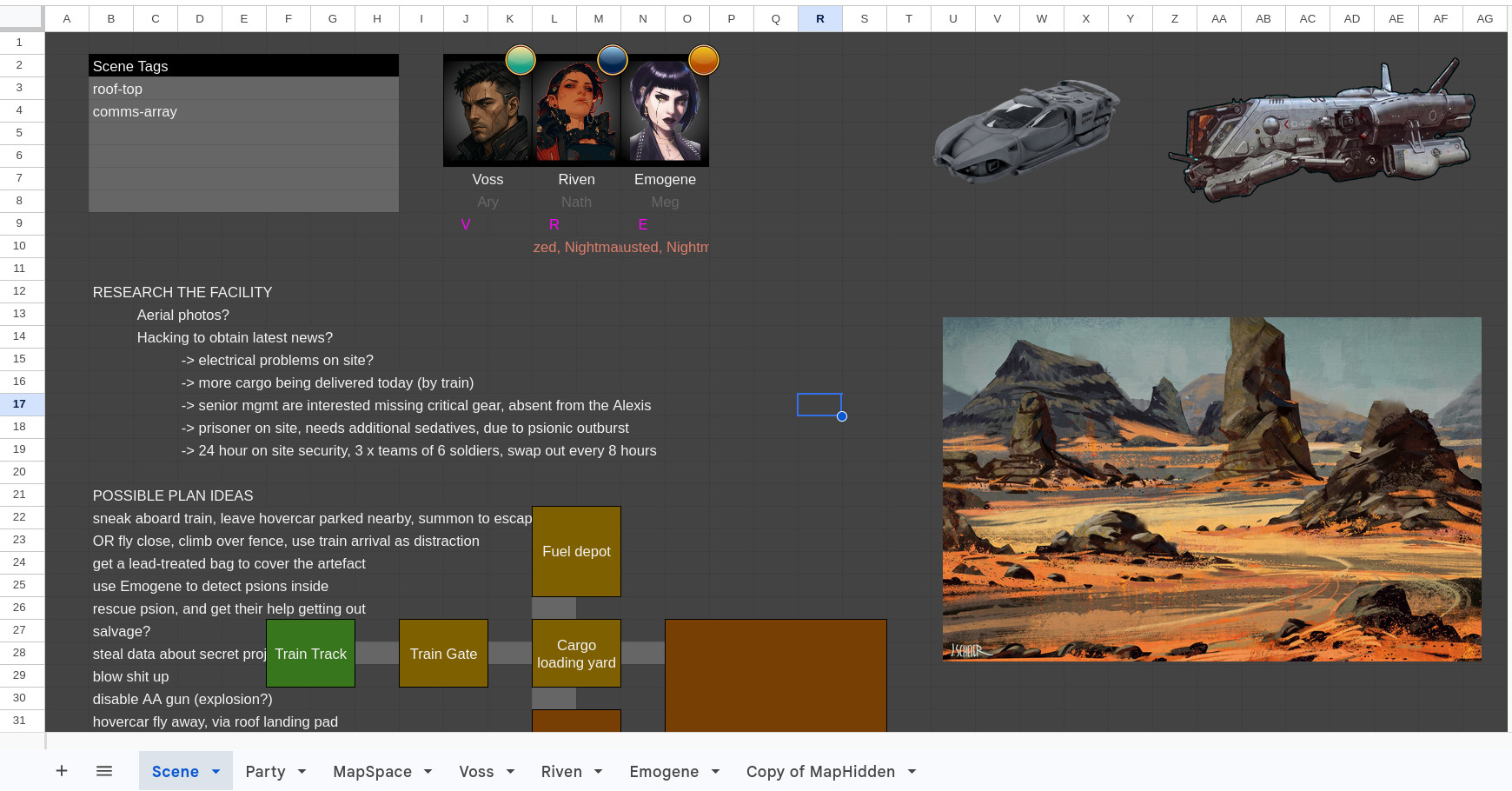
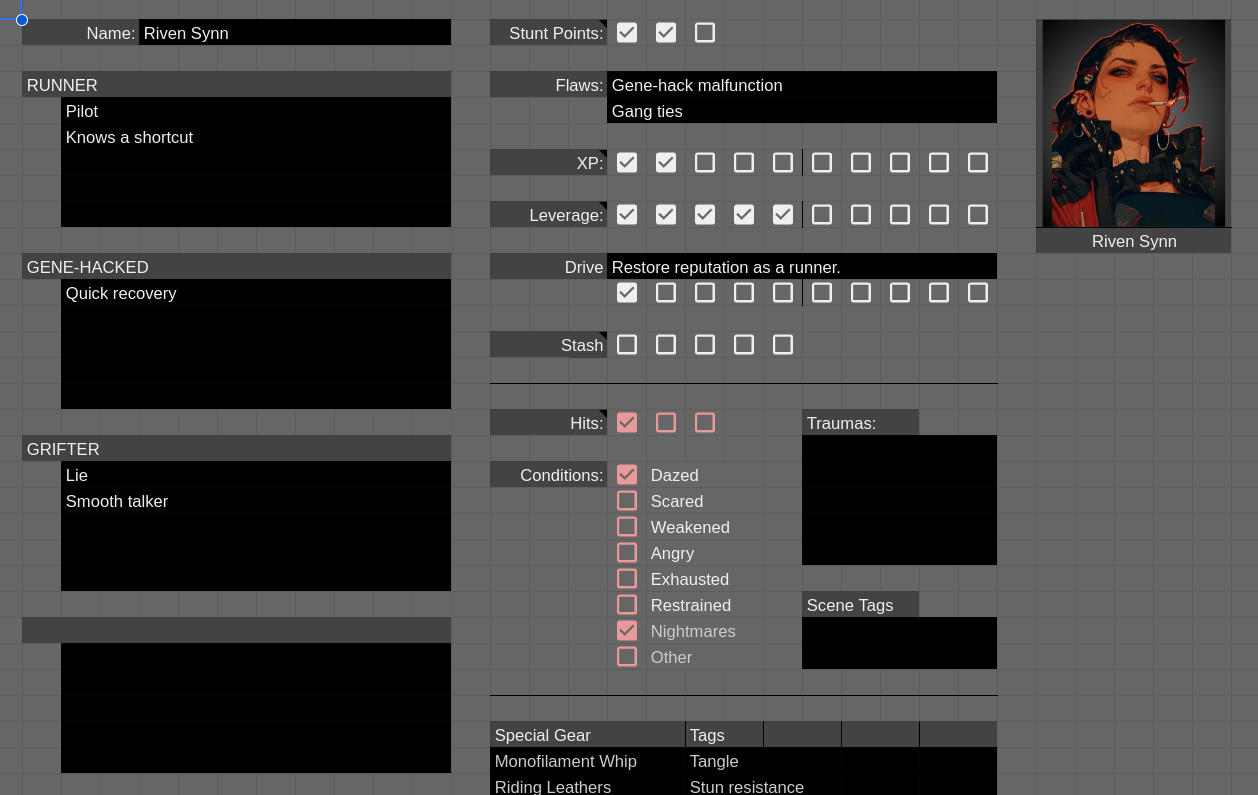
Core book, plus the Psions add-on book. We did not use a VTT, and instead I created a Google Sheet spreadsheet with tabs for each of the character sheets. The main tab of the document was used for throwing down images related to the scene, and listing tags for the scene, or names of NPCs, etc. It worked okay, even if I got annoyed with how Google Sheets handles images. We used this online dice roller (https://nco-diceroller.vercel.app).

Overview

Our campaign was set in a distant solar system, where contact with Earth has been lost and the corporations have taken over. Our PCs were; a bounty-hunter, a gene-modified pilot, a psion. We did a few city-based missions; for example breaking into a hotel room to steal a datapad, and using a city riot as cover while capturing a new model of police robot. We also used the Mothership adventure Dead Planet to explore an abandoned spaceship. Our campaign ended when one player could no longer continue.


The Good

  • Simple system. Character creation was easy. Simply flip through the suggested "Trademarks" available (e.g. Medic) and pick 2 "Edges" within each (e.g. Calm Under Pressure). In play, these Trademarks and Edges, combined with equipment Tags each give you bonus dice to roll. It was easy, and characters felt like they had different skillsets and abilities.
  • Easy to run a session. The job of the GM is lighter than other more traditional systems. Firstly, only players roll. So players are the only ones who need to worry about stats and numbers. This means the stat blocks for enemies are short and sweet. I just need to say, "The police robot lowers its stun gun and fires at you!" then the player needs to figure out their dodge dice pool and try save themselves. I found running sessions very easy and quickly got into the flow of describing what was happening and inventing escalating dangers for the party to deal with.
  • Prep is light. Not only is the game easy to run, it is also easy to prep. I just needed a broad concept for a mission, and a few twists and toys for the players to interact with. Honestly I think I coasted along a little too easily, and could have worked harder.
  • Well written rules text. The book has hardly any lore and fluff, and the text is direct and clear on what to do. What a pleasure to play and reference. The whole book is about 70 pages, with clear font and heading colours and chapters. Great!
  • Advancement system is straight-forward and also flexible. When you complete a mission, you earn 1-2 XP and also 1-3 Leverage. Leverage is supposed to represent money and favours with contacts; your ability to acquire equipment and intel. During downtime you can convert Leverage into XP, and also use it to buy elite new gear that grants additional tags. I found this to be really elegant.
  • The Not-So-Good

  • Zoomed out of details. Sometimes the thrill of Shadowrun or Cyberpunk is the nitty-gritty specificity. A player who has mastered the system, can buy an Ares Predator 2 pistol, apply the correct mods and enhancements, load it with the correct type of ammunition and end up with a satisfying synergy of awesome gun. This is how players who master the game mechanics are rewarded. Neon City Overdrive zooms out so this kind of system mastery is not needed. Your Ares Predator is now a gun with the Deadly tag. This is okay, I guess? It achieves the same end result, but there is a loss of granular detail.
  • Gambling gear in character creation. When you create a character, you get basic gear for free. Basic gear can be anything, but it does not give a bonus dice when used. You also get some Special gear. Special gear *does* give a bonus dice when used. You can have up to 4 items of Special gear, and you can decide how many Tags you want the item to have. "Quiet" is an example of a Tag you might put on an assassin's pistol. If you put only 1 Tag on an item, you get it. If you want additional Tags on a single item, you roll a dice to see if you get it. This felt a bit weird to me. We had one character who got lucky with a Super Awesome Mega gun, and other players didn't want to risk it and chose conservative items. This is the only randomised part of character creation.
  • Dangerous enemies need some tweaking of rules. There isn't a way to scale threats, except by adding more Hit points to them. It doesn't matter if you are fighting a squirrel or a tank, each Tag possessed by an enemy only adds 1 Danger dice to a player's dice roll. So, mechanically, a squirrel with "Nasty bite" and a tank with "Explosive shells" both only add +1 Danger dice. You need to stack Tags to pile on additional Danger tags. I guess it is up to the GM to use common sense and say that the tank's threat gives more than 1 Danger dice. But this is not rules-as-written, and none of the provided enemy stat blocks are built that way. I fumbled this in an early session, and a supposedly deadly alien threat felt weak.
  • Lacks a mechanism for ongoing situational disadvantage. Players have Trademarks and Edges, which are tags that give them a bonus to dicerolls. When it comes to negative tags, Conditions and Traumas seem to be the only tools that are available. Conditions are temporary (e.g. "Exhausted") and they apply in situations that make sense. The trouble is that, according to page 35, Conditions are not supposed to last longer than a scene. And Traumas are permanent tags that apply to *every roll*, regardless of what the roll is for (e.g. "Weakenned Heart"). (Which feels weird to me, as the example Traumas are things like "Missing Finger", "Wounded Pride"; and I can think of lots of situations when missing a finger would not matter at all, but Traumas always apply to every roll). What is missing is a mechanism for something like "Arachnaphobia" which is a permanent tag, but which only applies in certain situations. I just found myself houseruling that certain Conditions do not expire between scenes. Whenever I houserule something, it means the game was missing something I felt was necessary, so I am recording it here but it is not a big deal.
  • PCs need a few more tags. Your character has 3 main tags, with 5 sub-tags. In practice this didn't feel like quite enough for me. The tags are all skill and profession oriented, such as "Hacker" and "Infiltrator" and "Pilot". I would be generous and add a few more tags to starting characters, because our PCs felt like their skillsets were a little narrow focused.
  •  
     

    Verdict

    This is a great simple game that gets the job done. Players found it easy to learn and I found it easy to run and prep for. The disadvantages I have listed here are not very significant and I'd happily run this again.

    Useful?

    0

    No signup.
    Just let me know.


    Share this page


    © 2026 SpandexAndy