Mythic Bastionland

Posted 07 May 2026 to Fantasy

Knights travel the land to earn renown by pursuing Myths.


XP Card

Sessions GM'd: 0
Sessions as Player: Play by post, daily posts, 4 months

I Used

The core book only, as PDF. We played over Discord, using an online dice roller. I used a Google Sheet as my character sheet.

Overview

The Realm is a randomly generated hex map, sprinkled with a handful of Myths. Your party of Knights will travel across the region, encountering clues and signs of these Myths. In our campaign, we had three players, and I played the Saddle Knight. He was all about horses. His special ability was talking to horses and never being dismounted. I chose to play him as a spoiled little rich kid. We never concluded all of our Myths, as the game dissolved for real world reasons. But I really enjoyed my time with it.


The Good

  • Succinct rules. There is absolutely no waffle text. Everything is sharp and to the point. Every word is chosen with care. The basic player facing rules are explained in three pages. There are optional rules that cover extra situations like Warfare, which we never needed to use. About 10 pages explain to the GM how to build the world and run the game. I've noticed that many players (myself included!) are reluctant to want to read a 400 page book. This approach is perfect for easy accessibility.
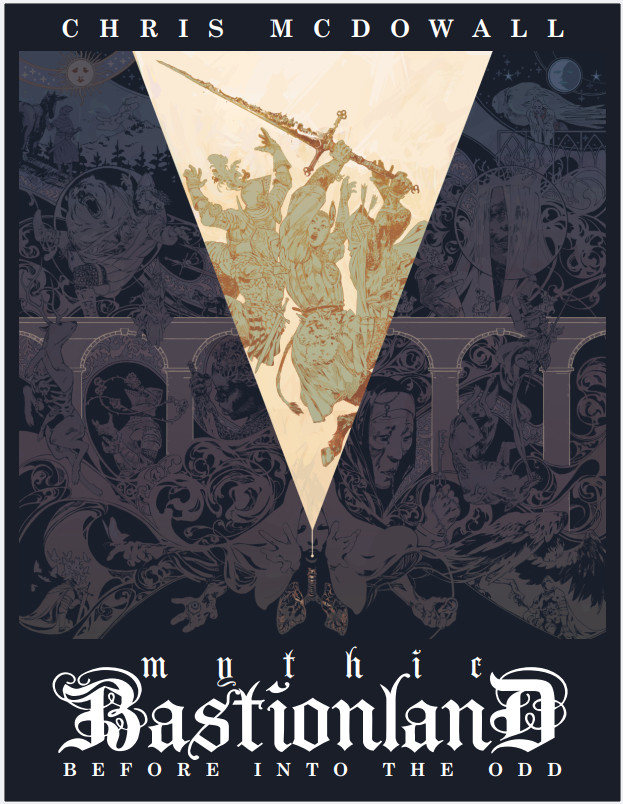
  • Beautiful art that keeps a consistent style. Each piece is quite detailed and reveals details when you study it for a few moments.
  • 72 Knights. A ton of knights are provided. Each knight is presented on a single page, which could also be your character sheet. You can pick the knight you want to play, or roll randomly. Each page is numbered with a d6 and d12 if you want to select one randomly. They are each very unique and give only broad ideas to suggest how you might play them.
  • 72 Myths. Each Myth is a threat to the realm and a mini adventure seed, presented on a single page. They covered every traditional monster I could think of, as well as a number of predicaments that require more than muscle to overcome. Each is presented as an escalating situation, using a list of Omens that count up from 1 to 6. The stats for NPCs related to the situation are on the same page.
  • Combat has a number of tactical options. The rules are very light. You do not have a stack of abilities that you can call upon, and the differentiation between each knight is not in their combat abilities. Rather the difference is the gear they carry. When in combat, every player rolls their attack dice, which might be (2d6 + 1d4, for a shortsword and shield) or (1d10, for a lance). You are looking for 4+, which allows you to move one of the special moves called a Gambit. You want as many as you can get. If you manage to get a 8+, which is only possible with the biggest weapons, then you can do a Strong Gambit. In play, this meant that we rolled our dice, bemoaned some of them and celebrated others, then leaned forward and spoke together. "Okay, how about you use your 5 to Impair the monster, then I will use my 4 to Bolster damage, and we save your 7 as the damage dice." This process feels fun and tactical, and simultaneously actually paints a little combat montage in your mind's eye. You can visualise the three knights doing those activities and working together as a team.
  • Spark tables. There are 36 small tables, 2d12 each, which are lists of adjectives to describe people, places, things, combat, and more. Very handy! I am going to include them in my random generators library. Here is a random NPC, created by rolling on the Appearance, Personality, Background, and Task tables: "Youthful gaudy, Spiritual craft, Academic escape, Transport gold". So I imagine a young student who has been studying religion and is now on a return journey home carrying funds for his tuition.
  • Mandatory downtime. At the end of each session, you choose how much time advances. You can also roll. If you want, a year or more can pass. In our game we advanced through the seasons of the year and it felt great to add a sense of scale and the movement of time.
  • The Not-So-Good

  • A bit weird. Apparently this is normal for work by Chris McDowall. Many of the myths (and knights for that matter) are quite out there. They are concepts or themes which can be hard for a practical group to come to grips with. For example, one of the Myths our group faced was The River. It really consisted of a couple of scenes related to water and there wasn't much our knights could do about it.
  • Some Myths do not really have a satisfying conclusion. They just kind of wrap up. This was the case for the River. It burst its banks and spread into a new hex. Okay. We'll go around I guess. Another was the Mountain. We never got to the end of this one, but reading it now it seems that one of the mountains in the realm is evil. And there's not much anybody can do about that. Nevertheless these Myths did create a number of colourful scenes which I suppose are a great opportunity to roleplay. Being the victorious knight is not always possible, and that's okay. Sometimes you're just present when history happens.
  • Limited replayability. Despite the fact that there are tons of knights you never got to play, and all those Myths you never got to experience, I do feel that we have "done" this game. If we started a new campaign, even if our GM generated a new realm and we used a new set of Knights and faced a new set of Myths, the vibe would be the same. While each Knight has their own special ability, one of the central assumptions is that you all have the same oath: Seek the Myths, Honour the Seers, Protect the Realm. So there is little scope to play a band of scoundrels, for example.
  •  
     

    Verdict

    I really enjoyed this game and found it to be really strong at conveying a very specialised experience. I don't think I need to play it again, not for a while anyway. I would really recommend everyone try it once.

    Useful?

    0

    No signup.
    Just let me know.


    Share this page


    © 2026 SpandexAndy