Dolmenwood

Posted 05 Mar 2026 to Fantasy

Old school survival simulation in a fairy forest.


XP Card

Sessions GM'd: 22
Sessions as Player: 0

I Used

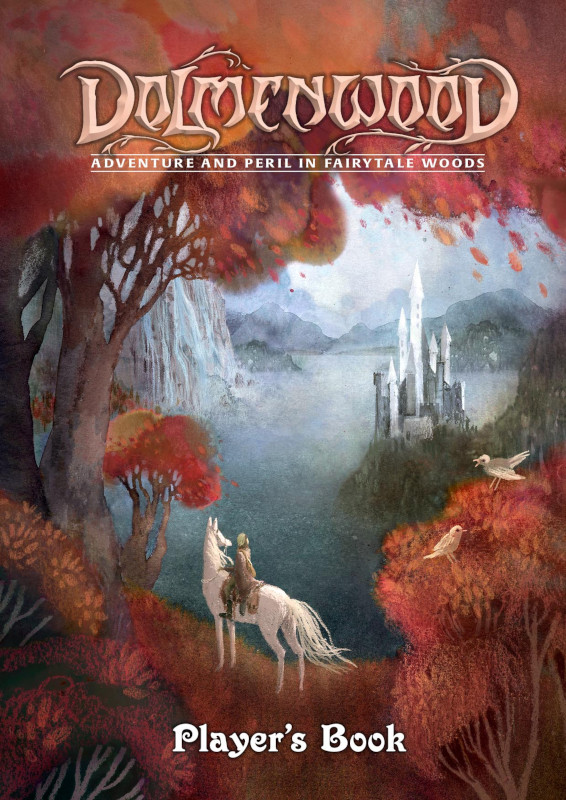
I had PDF copies of the 3 main books. I later also purchased a physical copy of the GMs Campaign Book, which was a really good idea. I ran the game online using Owlbear, with players and myself rolling physical dice and using offline character sheets.

Overview

The Dolmenwood books contain two things; a game system based on Old School Essentials, and a fairy forest setting. The setting is really comprehensive. It is rich and has thousands of little adventures hidden away. The system is also comprehensive, with many well-described sub systems and it is tightly interwoven with the setting. For this review, I am mostly only going to comment on the game system. I will write a separate article about the setting. I recruited two groups of players to run two parties through the forest. Some players had lots of experience in a variety of RPGs, and two players had never played anything before.


The Good

  • Incredible setting. It's consistent, it's full of flavour, it's evocative. It doesn't try to be a kitchen sink that pleases all tastes. It is laser focused on delivering homely English fairy forest vibes. There are a variety of factions, like orders of the church, witches, noble houses, which can play off each other as they each have goals.
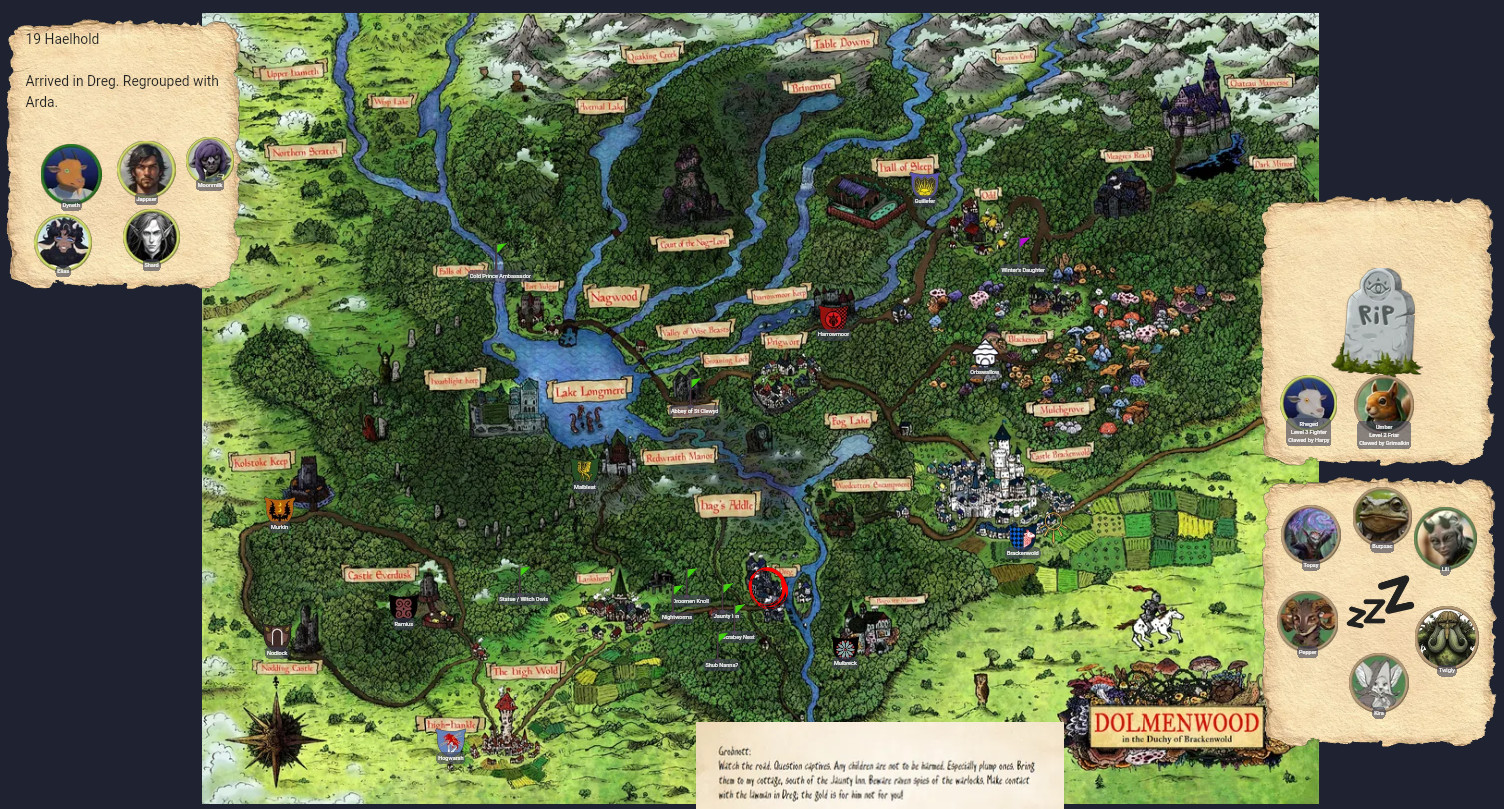
  • Detailed hexes for exploration. The whole forest is mapped with more than 200 hexes. Each hex is fully detailed on one or more pages, and each hex has something going on. There are years and years of playable content here, beautifully and clearly presented. The whole forest is about 8200 square miles (the size of Northern Ireland?). In play, players would climb a tree or get to a vantage point, and then I would tell them about landmarks and points of interest they can see in neighbouring six hexes. I gave players a copy of the player map (in the front cover of the player book) and used little pins in our VTT to mark key locations the party had adventure hooks about. This map is not drawn to scale, so the players do not know exactly what hex they are in, but are able to orient themselves nicely.
  • Good clear procedures. The player book has by-the-numbers instructions on how to run exploration scenes and combat scenes. How to move to a new hex. How to determine if a random encounter happens. How to search for herbs. The first page of each chapter has a sidebar that uses bullet points to summarise the mechanics described over the following pages. This clarity is great. At first you might think there are too many procedures; that it is too much to remember. But they are all optional. You don't need to use the procedure for Collecting Firewood unless it is relevant to your scene.
  • Good GM Tools. The GM book has solid guidelines for generating treasure, designing adventures, and coming up with campaign themes. I used these to generate the loot that the players found, and the random encounters to generate emergent stories as the players moved around the forest. In the later stages of the campaign I stopped using the treasure tables as much.
  • Bonus flavourful material. Apart from the normal equipment lists of weapons and armour, there are also pages that list and describe various kinds of smoking tobacco, different kinds of dogs for companions, assorted herbs and mushrooms, and a spread of ales and wines. All of these world building elements are quaint and reinforce the setting. Great stuff.
  • PDF has the best hyperlinking I've ever seen. There is a lot of content for a GM to manage. There are more than 200 hexes, for example. And tables for rolling everything. All of this content is hyperlinked in the PDF. For example, each hex has its own page in the book. Helpfully, there is also a minimap on each hex page, that shows the current hex in the center. You just need to click, on the minimap, on a neighbouring hex to jump to that page. The master map at the back of the book has hyperlinks for every hex.
  • Included adventure is great. The Pipes on Droomen Knoll is an adventure site which we explored over two and a half sessions and it was great fun. It introduced the setting and the system very well, and provided a few longer term story hooks that provided some stimulus during our campaign.
  • Active community. The Discord server has enthusiastic GMs who are creating new homebrew content every week and posting it generously for all to share. If you have a question, someone will answer within the same day. And nobody seems to have an attitude.
  • The Not-So-Good

  • Confusing OSR dice and terms. The author has made some effort to modernise the old school system and clean up terminology to make the game easier to teach. For example, they use ascending armour class, and spell level has been renamed spell rank. Good. But they could have gone further. The way the core dice mechanic is expressed took me a minute. "Roll 1d6 with a 2-in-6 chance of success". This means you need to roll 5 or 6 on a d6. Whereas 4-in-6 means you need to roll a 3 or higher. Instead of saying "Roll 1d6 with a 2-in-6 chance of success", why not just say, "Roll 1d6, target number 5?". Some might say I just need to reverse the dice roll direction, and aim to roll low. I suppose I could, but that adds complexity for new players, where sometimes you are aiming to roll high and other times low. Easily avoided by using better words to name your mechanic.
  • Saving throws could be better. If a giant spider bites you, you need to Save Versus Doom to avoid being poisoned. Why not call it Fortitude Save or Save Versus Toxin? Doom is so vague. None of your stats help any saving throws, so a high dexterity character is no better at Save Versus Ray than any other. (Save Versus Ray is the one to use when dodging something fast moving. Why not call it Evade Save, or something more intuitive?). I think that, in general, the players never really understood what each saving throw was supposed to be for.
  • I'm not a fan of the skill system. Many new GMs without OSE experience don't understand how skills in Dolmenwood work, as it is a frequent question on Reddit and the Discord. Several classes get skills, rated 6 to 1, where 1 is the best. (Yes that's right. These numbers go the opposite direction than all other numbers on your character sheet.) The situations where the skills are to be used is not immediately clear to players and GMs not versed in Old School D&D. For example, the Listen skill which the Bard and Thief get. Its only use is to listen at a door to detect a creature on the other side. This is not explained on either the Bard or Thief pages, but rather inside the Hazards and Challenges chapter. These skills also do not have a great chance of success. A level 1 Fighter needs to roll a 6 on a d6 to detect a creature by spending 10 minutes listening at a door. This number never improves for a Fighter. A Thief needs to roll a 5. Your stats do not modify your success chance with skills. There are no DCs for variable target difficulties. The success chance is so low that players quickly learn to not bother. Our party frequently resorted to just breaking a locked chest with a hammer and chisel rather than waiting around for the thief to spend 10 minutes to get a chance to roll 1d6 and try and get a 5. Which is a pity, because now the thief player doesn't get to roll dice when a rare thiefy situation arises. Some would say I should not have asked the Thief to roll - I should have just announced automatic success. But then what's the point of having a skill? If your skill system is so awful that you advise GMs to not use it, then there is a problem. Which situations require a Pick Lock roll, and which don't is unclear. The rulebook clearly says that all lock picking requires a roll. Yet all the skills have this fundamental uncertainty. Does a Hunter need to roll to use Tracking to follow the goblins, even when their chance of success is so low? Or does the GM just pronounce automatic success? Does an Enchanter always need to roll to detect magic? It's unclear and not great.
  • No index in the player book. Yes, hard to believe. In a game session, if you suddenly need to check how to sell loot, and can't remember what the resale value of gems is, you will need to do some page flipping. (It's in the Settlements chapter).
  • Some stats are hardly used. You generally do not add your stat modifier to most rolls. Combat attack rolls, add STR or DEX to hit, but CHA and WIS and INT are attractive dump stats for many characters. They do not affect any skills, or any saving throws, and the OSR philosophy generally has players solving problems with their own descriptions rather than with dice rolls. But it feels weird to even have a Wisdom stat if it does not affect anything a Cleric does. It does not affect their spells or abilities or any dice rolls. It only gives a minor XP bonus if 13+. I would have liked a way to use stats more in the game, because they are such a prominent part of character creation, and are front-and-center on the character sheet.
  • Economy and XP. There are several optional ways to award XP in the GM book. The default method is Gold for XP, where each 1gp collected earns 1xp (split between the party, so 0.25 XP each if there are 4 players). This is great because it encourages the party to seek ways to outfox enemies to get their treasure, rather than just hack and slash them. Unfortunately the numbers are not calibrated to my liking. A Fighter needs 2000xp to reach level 2. This means that a level 2 Fighter is a millionaire. After buying a horse, plate mail and a two handed sword, and hiring 30 villagers to accompany him for 30 days ... he still has only used half his wealth. A party of 4 level 2 characters has earned 8000gp. An immense sum. I like the principle of awarding XP for gold, but I would have preferred if the economy had been adjusted so that less XP was needed to level up, and expected treasure rewards were also reduced. I came away from this campaign convinced that old school D&D requires a terrible economy which is out of whack with the setting. An overhaul could fix it, but I guess the author had hands tied because they wanted their game to be compatible with old school published adventures. I had to introduce a house rule, recommended by GMs on Reddit, to nerf money rewards.
  • Hireling tracking requires a spreadsheet. The OSR Dolmenwood system is a simulation. To improve survivability, your players are encouraged to hire tagalongs to help carry treasure and to ameliorate risk by being an extra body that enemies can target sometimes. I really grew to dislike this. The trade off for players is that they earn less XP while hirelings accompany them, however their survivability is improved. Tracking hireling XP exactly means you need to track how much XP is earned by the party (as normal), and then apportion percentages of that XP to hirelings and retainers. Hirelings each earn XP at 50% the rate of players, and advance at rates that vary by class. You need to do the same for gold and treasure. Here is an example of a spreadsheet that another GM created to manage this (link). It is crazy. I wasn't going to do that, and sensibly told my players to track their hirelings themselves. And, honestly, while it is realistic for a party to hire a gang of cardboard cutouts to carry their things and fight alongside them, I'm not sure my table enjoys a style of play that adds an ever increasing roster of tag-alongs. By level 4, our 5 players had a party of 12 characters.
  • Randomly high lethality. I understand that one of the core ideas of OSR play is high lethality. Players should aim to avoid combat because it can kill you. I'm fine with that. Monsters are a puzzle to solve, not a bag of hit points to deplete. But many of the monsters in Dolmenwood are devastating to a party, without any warning. The random encounter tables include monsters that have gaze attacks (no cooldown, or limited use) that require the whole party to save; at least one person is going to fail. These monsters are not solo bosses - they are found in groups. Like the Harpy, a monster encountered in groups of 2d4 who has an area effect charm ability with permanent duration. A failed save should debilitate you, or permanently scar you. But immediate death is a pretty boring and irreversible outcome. Quick death and disposable characters is not a style of play that suits my table. I found myself nerfing monsters that would otherwise be very cool to use, or just not using their more powerful abilities. Other games, such as Forbidden Lands and Shadow of the Demon Lord present dangerous monsters that do interesting things, without falling back to Save Or Die.
  • Too many abilities remove player agency. I don't like abilities that charm or paralyse or otherwise remove fun from a player's agency. I looked through all the monsters in the Monster Book and counted 28 out of 89 have one of: Save-Or-Die, Save-Or-Paralysis, Save-Or-Charm, or Save-Or-Permanent-Stat-Loss. That's 30% of all monsters. One of the racial abilities for the Grimalkin (cat person) triggers 2d4 rounds of berserk attacking friend or foe. This resulted in the death of one of our PCs, when our squirrel Cobbin friar tried to stand between a berserk player and an innocent bystander NPC. It was a noble sacrifice. The grimalkin player later said to me that they felt they had lost control of playing their character in order to satisfy a game mechanic.
  • Treasure Tables are a lottery. Congratulations! You have just completed clearing the dungeon that was the lair of a pack of manticores. The treasure guidelines say there is a 85% chance that you find no magic items. Nada. This is highly deflating. Remember that XP is largely gained through treasure. However, if you are lucky, and find a treasure, the value of it is likely to be huge. For example, a magic staff worth 35 000 gold pieces. Now everyone goes up a level, even though nobody can use the staff. Either you win big or you get squat. I'd prefer if the rewards were flattened. I think Shadowdark has better random treasure generation. So instead, I tended to manually handpick treasure, which feels lame and less simulationist.
  • House Rules are expected. Judging from replies I get to my questions on Reddit and on the Discord, hardly anyone plays all the rules as written. We houseruled some things immediately and a few more things as we played. Firstly we reduced lethality by not having insta-death at 0hp, allowing a save versus death every turn while awaiting first aid. Secondly, we increased the natural healing rate; basing it on max hp rather than only 1hp per day. Part of me is excited that the Dolmenwood community embraces homebrew tinkering. But part of me is disappointed in that a GM needs to be part-time game designer on top of their other responsibilities. One of the players noted that by changing the lethality of the game, we perhaps significantly changed the tone of the game. It became more whimsical and less horror fantasy. Fair comment. Maybe introducing house rules immediately invalidates this review! Caveat lector.
  •  
     

    Verdict

    Having bounced off super-heroic power levels in my last campaign (Shadow of the Weird Wizard), I am now bouncing off highly lethal simulationist OSR play. The sweet spot for my tastes is hard to find! And I think I already found it in Shadow of the Demon Lord or Forbidden Lands. I have nothing but praise for the Dolmenwood setting - it is wonderful and detailed at just the right level for me. But the BX-based game system is not quite my cup of tea.

    Useful?

    6

    No signup.
    Just let me know.


    Share this page


    © 2026 SpandexAndy