Wildsea

Posted 29 Oct 2024 to Fantasy

Nautical adventures on a sea of vegetation, riding a chainsaw boat.


XP Card

Sessions GM'd: 0
Sessions as Player: 3

I Used

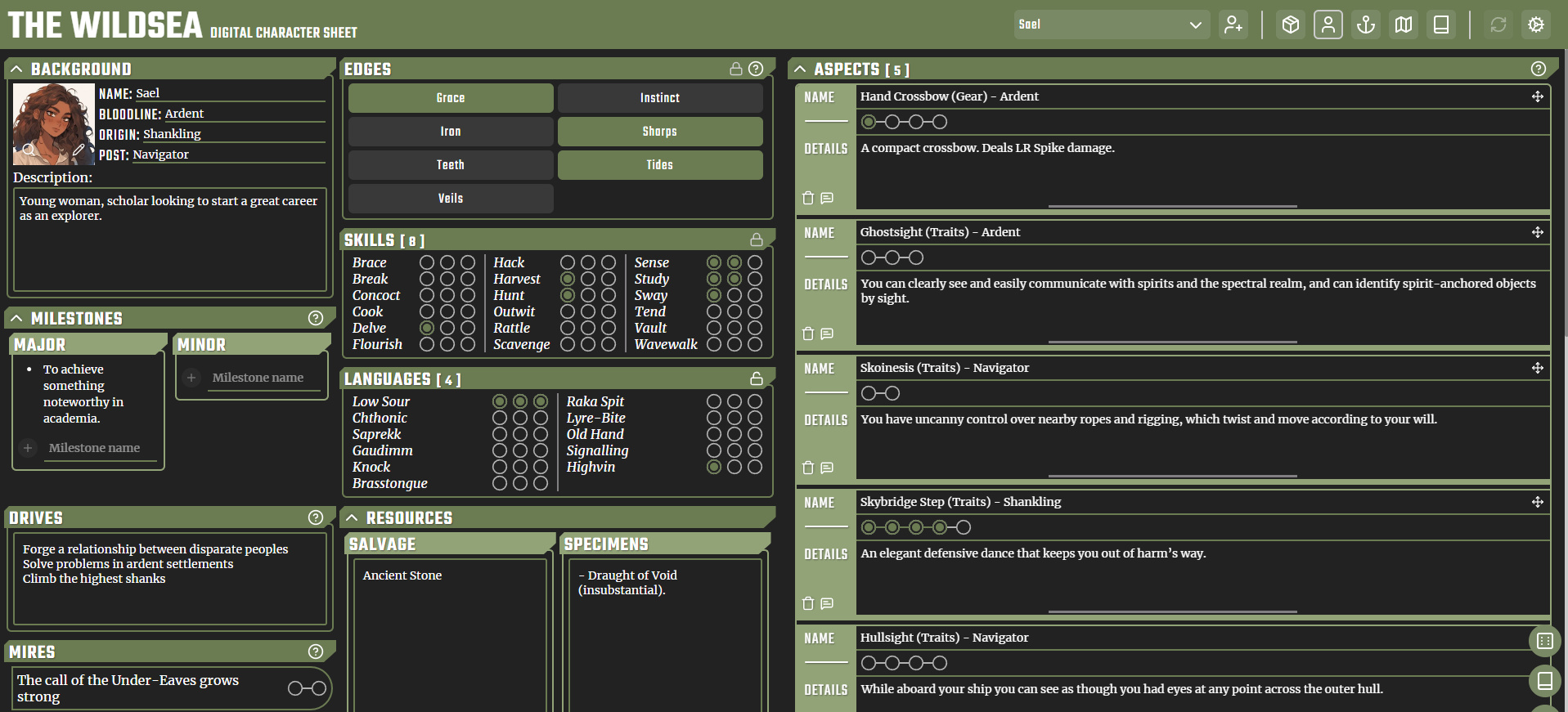
Core book. 185 pages of spreads. We used the https://wildsea.charsmith.com/ website, which had all the tools to play.

Overview

I was intrigued by Wildsea when it was first released, but I didn't back the Kickstarter. The art was beautiful, the setting was zany and captivating, and it said that it took inspiration from 13th Age. I adopted a wait-and-see attitude to the game. Now in 2024, it was time to see. A friend offered to run a short taster mini-game, and we got underway. I created an Ardent Navigator character, a plucky young woman with deep intuition and a sense of the spirits. The other characters in our group were; an Ironbound (robot) bruiser, a Mothryn (moth-person) Dredger who braves the darker undergrowth to search for loot, and an Ardent big rifle hunter. We were captured by pirates, and our precious loot - an unhatched magical egg, taken from us.


The Good

  • Art is amazing. Consistent style, evocative dreamlike chapter art. The style is similar to the Dragon Prince animated TV show, and it is colourful and crisp. Some of the concepts for the setting are quite unusual, and the art really helps to bring the setting to life.
  • Improvisational tools. The game structures allow and encourage low prep. Many tables are provided for the GM to roll on to help spark creativity. For example, during a journey we rolled a random event, and found an old shipwreck. We went down to explore it. We made a few rolls to avoid notice by some sentient vines, and got into the captain's quarters. We found the log book which had some intel that would help future rolls. This whole scene, fully evocative, was easy to improvise because the reward (logbook) does not need to be spelled out, it is just an idea (similar to a Fate Aspect) which can be used in a future scene to give a bonus.
  • Tracks for everything. Similar to Tracks in Ironsworn, or Clocks from Blades in the Dark, many objectives and story beats use boxes which are ticked off as you make progress.These set the difficulty of projects or scenes and are also used to track the expenditure of your skills and gear. I love this. It is elegant and intuitive. It is also another tool that encourages improvisation. In our game, our journey to find the enemy ship was a track. Our battle with the enemy captain was also a track. As we rolled skill checks and concluded scenes, we filled in dots on the track. I enjoy this kind of mechanism. It is very flexible, and intuitive to use. It feels like a movie and works well.
  • Incredible setting. Every now and then I read something that opens my mind and triggers my imagination. I am humbled when I realise (again) how rich some people's imaginations are! This is a setting that is weird and wonderful. It's fantasy, but thankfully without elves and dwarves. Rather there are moth-people and spider-people and fungus-people, riding weird-science ships around a sea of plants. We search the darker depths for salvage, and meet strange towns on islands which might be enclaves of a cult or pirates. There is a lot of freedom, and concepts are loose, which allows a lot of freedom. Intentionally, a map is not provided, because they want a lot of white space for each game table to make the setting their own.
  • Great website for tracking your campaign. We used the wildsea.charsmith.com website, which guided the players through creating their characters and also provided tools like a dice roller and random table roller for us to use in game. The rolls were visible to all players in the game, and we did not need to use a VTT.
  • Focus tracking. The GM chapter of the book gives good guidelines to help manage spotlight time between players. It is suggested that the GM has the names of the characters on a piece of paper in front of them. As players fluidly take focus in a scene, the GM marks "A" for action or "R" for reaction next to their names. By glancing at this list, the GM can easily see which players are hogging the scene, and which need to be invited to contribute. This is a great simple tool, and I hope to use it in other games. The online character sheet we used incorporated this tool on the GM's tab.
  • Actionable, specific, excellent guides in the GM chapter. There are guidelines on how to run a scene, how to set up tracks, how to present the world, how to hand out resources. Sometimes GM chapters can be full of waffle and loose suggestions, but the chapter in Wildsea is very specific. There are bullet lists of ideas, and each short paragraph has a bold one-liner summary. It is readable and a very good tool.
  • The Not-So-Good

  • Stats are a bit unintuitive. Some of their naming is unnecessarily obscure. When I look at my character sheet, I can guess what the Grace stat does (dexterity) and the Instinct stat is also understandable. But what about the stat called "Teeth"? Or "Tides"? Some of the names for abilities took a bit of getting used to, and felt a bit pretentious.
  • Narrative games feel artificial to me. This is a personal preference. I'm a bit of a simulationist. Games like Wildsea or Blades in the Dark encourage players to get involved in creating scenes and describing the outcomes of dice rolls. Such games allow players to do more than merely peek behind the GM screen, they can improvise and assume some of the story-telling responsibilities. As such, narrative games like this can feel like you are just playing make believe. They have a different feeling than a traditional RPG. I am aware this is just an illusion - all RPGs are just make believe, obviously. But gameplay feels somehow different to me, less real.
  • Resources are fiction. On your character sheet, you have four types of resource; Salvage, Specimens, Whispers (mystical stuff), Charts (documents). These resources are "consumed" in the fiction when you try to use them in a scene. Healing your aspects (e.g. recovering points you spent to use your abilities) requires consuming these resources in a descriptive scene. This process didn't gel with me. In our game, my character had used up several dots on my Skybridge Step track (a dodge ability) during a bar brawl. I was given a resource called "Uneasy Rest" that allowed my character to have a sleep while travelling. My dice roll consumed the Uneasy Rest, but failed to recover my dodge ability. It felt weird. Not intuitive.
  •  
     

    Verdict

    A well-structured story game in a wonderful setting. I'd like to play it again, and give it a longer try. There are some game mechanics that we didn't fully explore, such as Journeys.

    Useful?

    1

    No signup.
    Just let me know.


    Share this page


    © 2026 SpandexAndy